Sam Zell, a self-made real estate titan, is here speaking with the crew on CNBC. Fortunately, they actually let him talk without bulldozing him with agenda based questions. Zell truly has a 20,000ft view of the economy, and he always speaks his mind. His prognosis is not the rosiest.
"We need leadership, not criticism. We need encouragement, not discouragement..."
- Sam Zell
SAM ZELL CNBC INTERVIEW

MONEY IN STEREO
Tuesday, October 2, 2012

The Fraud Files
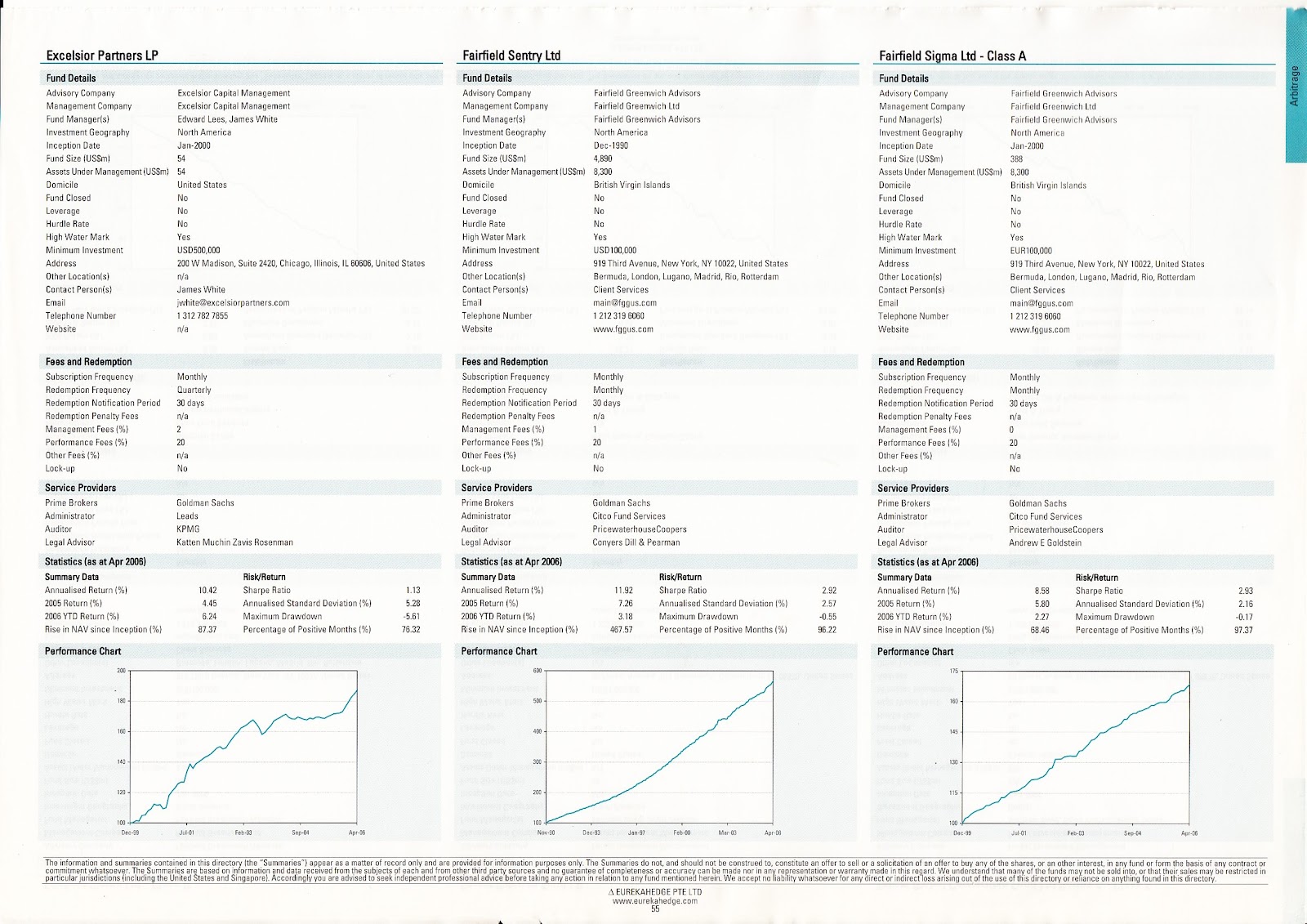
An interesting and quick read found via Santangel's Review showing the chart of one of the Madoff feeder funds. Of course hindsight is 20/20, but looking at the chart of the Fairfield Sentry Fund is truly amazing...if it were real. Cliche I know, but typically if things are too good to be true, then they are. As Charlie Munger says, "There is no way to get rich with soft white hands." Another quote that comes to mind is that of Richard Feynman which says, "The first principle is that you must not fool yourself - and you are the easiest person to fool." I would imagine after being conditioned for decades of steadily upward performance, that one could start to believe in the viability of such "remarkable" performance.
Sentry Fund Fraud Chart

Sentry Fund Fraud Chart
Not so New
Keith Trauner and Larry Pitkowsky are the founders of the Goodhaven Fund (GOODX). The fund is relatively new, but Trauner and Pitkowsky are not, having been integral parts of the team at Fairholme (FAIRX) with Bruce Berkowitz thru his finest years of out performance. The interview linked below talks about their time at Fariholme, their philosophy and understanding of value investing, and the low down on some of their current favorite ideas.
The fund has put up decent numbers in its short existence, beating the S&P this year, though lagging a bit since inception in 2011. Typically value will lag in a rising market as we have seen recently, but that is not all bad. It is a sign that the managers have a clear cut value investment process that they are sticking to. The true test will be in a significant market draw down. If the GOODX managers truly invest with a Ben Graham-like margin of safety, then the fund's downside should be mitigated. Furthermore, the managers have a significant portion of their personal wealth invested in the fund, so you can be assured that portfolio decisions are being made with shareholders best interest in mind.
GOODHAVEN INTERVIEW

disclosure: this is not a recommendation to purchase any securities mentioned in this post or anywhere on the blog. This blog strictly expresses the opinions of the author.
The fund has put up decent numbers in its short existence, beating the S&P this year, though lagging a bit since inception in 2011. Typically value will lag in a rising market as we have seen recently, but that is not all bad. It is a sign that the managers have a clear cut value investment process that they are sticking to. The true test will be in a significant market draw down. If the GOODX managers truly invest with a Ben Graham-like margin of safety, then the fund's downside should be mitigated. Furthermore, the managers have a significant portion of their personal wealth invested in the fund, so you can be assured that portfolio decisions are being made with shareholders best interest in mind.
GOODHAVEN INTERVIEW

disclosure: this is not a recommendation to purchase any securities mentioned in this post or anywhere on the blog. This blog strictly expresses the opinions of the author.
Monday, October 1, 2012
Music page update
FYI - I added a few songs to the TUNES tab in the Amazon player. I ran across Anders Osborne, Junior Brown, Michael Kiwanuka, and another Bass Drum of Death track I thought I should share. The drummer from BDOD is leaving for undisclosed reasons. That's a bummer because he was a real bruiser when we saw them live at One Eyed Jack's in New Orleans. Not sure how that will affect things going forward, but BDOD did say that a new LP was hitting the shelves soon. Looking forward to that!
Recent commentary from FPA's Bob Rodriguez - "All In!"
"It is all about not underperforming the market or a benchmark, so don’t fight the Fed. Unfortunately, a strategy of following the Fed’s urging to take on greater risk will likely end in heartbreak. Should the stock market continue its upward march, both our clients and FPA’s portfolio managers will be tested. This is a time for discipline. Given that economic growth is languid at best and is likely slowing, the divergence between the stock market and economic reality cannot be sustained. One or the other has to adjust."
- Bob Rodriguez
Embedded below is Bob Rodriguez's latest commentary about the Fed's recent QE Infinity announcement. That was a couple weeks ago, and the market's optimism about the maneuver is already fading.
all-in-commentary-9-2012BC714505E176
- Bob Rodriguez
Embedded below is Bob Rodriguez's latest commentary about the Fed's recent QE Infinity announcement. That was a couple weeks ago, and the market's optimism about the maneuver is already fading.
all-in-commentary-9-2012BC714505E176
Saturday, September 29, 2012
Pain is sending a message.
I found the excerpt below via the always insightful Farnam Street Blog.
“When we encounter pain, we are at an important juncture in our decision-making process.”
It is a fundamental law of nature that to evolve one has to push one’s limits, which is painful, in order to gain strength—whether it’s in the form of lifting weights, facing problems head-on, or in any other way. Nature gave us pain as a messaging device to tell us that we are approaching, or that we have exceeded, our limits in some way. At the same time, nature made the process of getting stronger require us to push our limits. Gaining strength is the adaptation process of the body and the mind to encountering one’s limits, which is painful. In other words, both pain and strength typically result from encountering one’s barriers. When we encounter pain, we are at an important juncture in our decision-making process.
Most people react to pain badly. They have “fight or flight” reactions to it: they either strike out at whatever brought them the pain or they try to run away from it. As a result, they don’t learn to find ways around their barriers, so they encounter them over and over again and make little or no progress toward what they want.— Ray Dalio
Friday, July 20, 2012
Ray Dalio - Bridgewater 2012 Q2 Letter to Investors
Ray Dalio, one of the few macro mavens worth listening to, recently came out with his 2012 Q2 letter to investors.
On an interconnected global economy:
"The breadth of this slowdown creates a dangerous dynamic because, given the inter-connectedness of economies and capital flows, one country's decline tends to reinforce another's, making a self-reinforcing global decline more likely and a reversal more difficult to produce."
If China is truly slowing down it's important to think about how this affects the price of commodities and similar inputs to the Chinese economy. How will that affect export countries of those goods?
On Stocks:
On an interconnected global economy:
"The breadth of this slowdown creates a dangerous dynamic because, given the inter-connectedness of economies and capital flows, one country's decline tends to reinforce another's, making a self-reinforcing global decline more likely and a reversal more difficult to produce."
If China is truly slowing down it's important to think about how this affects the price of commodities and similar inputs to the Chinese economy. How will that affect export countries of those goods?
On Stocks:
Subscribe to:
Posts (Atom)